Monday, August 22, 2011

Grimes


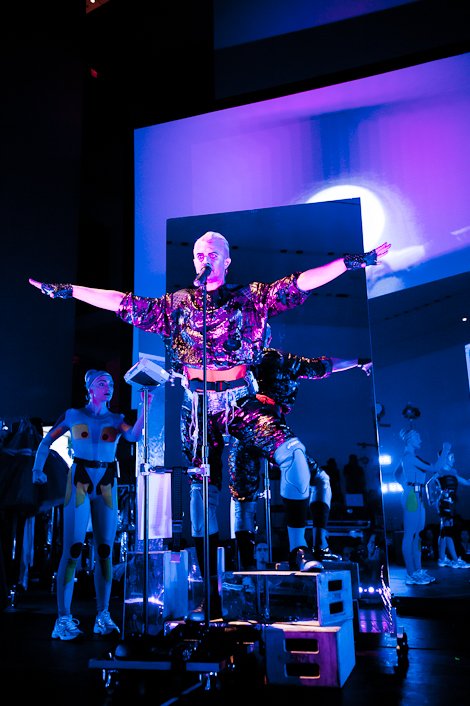
Last month, I spoke with Brandon Stosuy about the selection process for Warm Up, the performance series that's been happening in the courtyard of PS 1 on Saturday afternoons this summer. An editor at Pitchfork and contributing editor at The Believer (he is their in-house metal correspondent), Stosuy had found a kindred mind in fellow committee member Kris Chen of XL Recordings. Both of them were really into Claire Boucher, professionally known as Grimes.


It's probably worth mentioning that the art from the above clip is Grimes' own, as are the paintings for the posters and cover art for her albums Halifaxa (2010) and Geidi Primes (2011). 


Saturday was the ninth time the rising neuroscience student played in New York, and notwithstanding a technical difficulty, her set was rock solid. Boucher later remarked at how different the venue was from what she was used to. From doing shows with the soulful, strings-inflected How to Dress Well, and the rave-y, sugary Gobble Gobble (now known as Born Gold), her experiences have happily occupied the extremes of "a quiet, emotive show, where everyone's paying attention," and "a really crazy dance party."


Darkbloom (2011), Grimes' split LP with D'EON, is available on Insound and Amazon.

Tuesday, August 16, 2011

Not as Bad as It Sounds

A year ago, the New York Observer ran a piece mentioning some of the ways bands and promoters profit when they apply force to the term "artist" in describing themselves. It went with some research I was doing for a post about music programming in museums, and has birthed the following list of groups that have at one point or another been called "art bands." Oil yourself up and join in the verbal slippage.


Japanther


Members of Japanther met while students at Pratt, and they've operated in both realms (crafting their own microphones and instruments, making documentary films), playing five shows at major museums in the past two years. Somehow, when people think "art band," they think Japanther. In 2006, they made an abstract video for the Whitney Biennial, collaborating with no less than Dan Graham. Only that last point sounds a little sexed-up, though I didn't see the show and I do not hate their music. More power to them.

Ssion

Ssion, an “art performance collective” founded by then-art student Cody Critcheloe, had three shows in one weekend at PS 1 to coincide with the release of their LP Bent this past spring. This, I truly regret not seeing. The 2008 show in Chicago in which they opened for CSS was the epitome of good times.

Fischerspooner

Fischerspooner during their "pop spectacle" Between Worlds at the MoMA reopening, 2009. Image via NYTimes.
Fischerspooner is a “performance troupe” (which sounds okay) and "electroclash duo" (which sounds hideous). They were probably an easy pick to play at Warm Up in 1999; the stretch to calling them artists isn't a stretch at all, they had solid footing in the gallery system before finding an audience in the music world. Also, they dress funny.

David Byrne
Image via Wired
As I imagine it, Talking Heads was making "art rock" when Cody Critcheloe's dad was chasing his mom around the middle school dance.  Incidentally, he also makes sculpture and has pioneered efforts to establish Powerpoint as a legitimate art form. I want to be just like him when I grow up.

Tuesday, August 2, 2011

Jim Dine: The Glyptotek Drawings at the Morgan Library

Jim Dine. The Glyptotek Drawings. 1987-88. Charcoal, enamel paint, and india ink on paper. 17 x 12 7/8 inches. Photograph courtesy of The Pace Gallery. (c) 2011 Jim Dine / Artists Rights Society (ARS), New York


The thrill, supposedly, should come from seeing such work through an exceptionally gifted set of eyes and hands—as Dine described himself in a 2004 podcast at the National Gallery in DC. Unconvinced when I first heard it, I wanted to retort with a complaint once overheard after the showing of a latter-day Charlie Chaplin movie: “I don’t care if he is a genius. I don’t like that man.”


Read the full post on Art Fag City here.

Monday, August 1, 2011

William Corwin at the Clocktower Gallery

Wiliam Corwin uses sculpture to explore the way people catalogue information and organize the ties that link one idea to another. It brings to mind a lot of the things that interest me about R. Justin Stewart's work, though while Stewart has focussed on creating works that refigure sets of information in a new and insightful way (e.g. relationships between former Google executives, the lines and stops of the Minneapolis transit system), Corwin's sculptures have no referent set of data.


Installation view: William Corwin, Double Rood installation in Auroch's Library, 2011. Wood, plaster, found objects.  
Auroch's Library, Corwin's site-specific sculpture, is a chart that doesn't clearly refer to any place or thing. I saw the piece at the Clocktower Gallery on Leonard Street in lower Manhattan with a friend, and, to be fair, did not do most of the talking. Corwin is interested in military history, and there was a list of Civil War battles tacked to the wall, though it was hard to connect to specific facts about the installation either from his artist's statement or conversations with him at the gallery. What's most compelling is the library's structure (built in a vigorously simple arrangement of beams and shelves that is almost completely free-standing); from what I could tell, it's the organization itself in Auroch's Library that we're supposed to see, look at, and walk around.


The same might be true for a living sculpture event taking place next week where pieces from Auroch's Library will be used in a live chess game. While Grandmaster Robert Hess and International Master Irina Krush play, each of the pieces will be connected to a rope attached at the ceiling to a long stairway, supposedly to impede the order and purity of a more traditional match. A somewhat less serious example of live-competition-as-art might be the mock naval battles Duke Riley staged in Queens two summers ago.


I've actually never seen a Grand Chess Master play before, so the match for it's own sake should be worth checking out. It will be taking place at the Clocktower Gallery, adjacent to Air International Radio, on the 13th floor of 108 Leonard Street, on Wednesday, August 10th. The event will be free and open to the public. Check back later for time.

Friday, July 29, 2011

Class Actress at Pier 54

Metronomy
Photo of Metronomy courtesy David Louiaza
Last night Metronomy put on a great (free) show at Pier 54 on the Hudson River. Between songs in a slightly bumpy set, producer Joseph Mount's charm knew no bounds as he apologized for a fumble in a saxophone solo, telling the crowd, "We should acknowledge these things."


Opener Class Actress went under-appreciated, perhaps because the sun hadn't quite gone down during their set, which didn't quite suit the band's heavier-toned beats or the general seriousness of vocalist Elizabeth Harper's timbre. This is music you're supposed to hear in the dark.


Case in point: the title track on their Journal of Ardency LP:


...and off their upcoming release:

Friday, July 8, 2011

Kevin Curran Interview: Part III

Read the first and second parts of my interview with Kevin Curran, Bushwick-based artist and curatorial director of The Laundromat.

Kevin Curran: It sounds to me like what your asking is, “Where is this all going? What’s your plan? What’s your goal?” Whether it be in my own studio, or in curating, or whatever.


Reid Singer: Yeah. I freely acknowledge that it can be dicey.

KC: What do you mean?

RS: Well, first of all, people’s ambitions and their egos are very delicately woven together, like, “What are your dreams, man?”

KC: That also borders on being dangerously sincere. [We both snigger.]

RS: Well, I’m really curious and I didn’t know quite how to phrase it the first time.

KC: Well, obviously everyone wants to be recognized for what they’re doing. It’s sort of like when you start applying to graduate school or whatever, and then you start to sort of realize, the next year, when you’re in graduate school and you see people applying, everyone says, “It’s a roll of the dice. It’s the people who are in that room at that moment, and what they’re thinking about at that time.” It gets so murky, that value judgement about you. As the person who’s applying, it’s so personal. It’s so painful to get rejected from stuff. Everyone in graduate school thinks they’re going to get their first show, their first solo show in New York at this time, and it’s going to happen, and I’m going to be with all these collectors, and blah blah blah.

The one thing I would say is at least my approach to it has been that I just want to get involved in all aspects of what it is to be an artist, so I am into studying about art, and looking at art. I’m into teaching art classes, and talking to students about their art, and what I think.

That really helps me think about art myself: looking at art, teaching about art, working in exhibitions, organizing shows, seeing how people react to art, and then making my own art. All these things. Every angle. Sometimes I think about it that way. I’m going to work every angle.

RS: That’s one of your goals?

KC: Yeah, just get into everything. I will learn more that way, about art, about myself, about different attitudes, about what people think about art, all that stuff. Maybe I have a short attention span. Maybe I like to jump around and not be just focused on one thing.

RS: What’s the longest amount of time, for example, that you’ve spent just making art? Or does that not even happen?

KC: Well, I’ve made pieces that have taken me months to make.

RS: But during that time, were you exposing yourself to anything else that would’ve affected your process? Have you ever been devoting your energy just to making art, or teaching?

KC: Well, yeah. For instance, the last two years I’ve been in Japan, I’ve been teaching art history, and I don’t have a background in art history, so, just out of necessity, I haven’t had that much time to make my own work.

RS: What category of art history were you teaching?

KC: I teach a real easy one. I teach the survey from Giotto to now, and I also teach Modern Art, which is like Post-war, which has been great for me. I’ve learned a ton. I’ve looked at so much work. At Yves Klein, or Piero Manzoni, people who you don’t really hear much about but who are really amazing. Or even somebody like Francis Bacon, who might be out of style now.

RS: How long ago was that Met show of his? Two or three years ago?

KC: Oh, I don’t even remember. So, there are periods where I’ve had no time to do anything but study and teach. When I had a show in Tokyo in 2009, and I was teaching, but I had this solo show, I was working my ass off, every second I had that wasn’t devoted to working with students, I was hiring assistants, and making my sculptures, and working on my installation. It goes in fits. There’ll be periods where I’m very, very busy on one thing, and it’ll change and I’ll be very busy with something else.

RS: To pay the rent and everything, just making that happen, are you happy with how you’re having to budget your time lately?

KC: Well, no. Obviously, I’d rather just work and sell my work.

RS: I mean are you relatively satisfied, things being as they are, your constraints being as they are?

KC: Well, recently, I just took a job where I work four days a week instead of five. It’s at a gallery and I do like it, because I get to listen in on them talk to their clients and how they talk about art. I never really had any exposure to that, at a high-end gallery. How they work it. How they create the aura of desire around these things. That’s been really interesting. Also, the historical contexts that they put on things, like, “How do you establish value?” I’ve heard some very frank conversations about these issues, which I find very interesting.

Ideally, I then have a third day, that three-day weekend to work in my studio. I work at night from ten ‘til one in the morning. I do have more of a routine now, but I’m leaving in three weeks, so it’ll be all up in the air again.

RS: Are you excited to be getting back to Japan?

KC: Absolutely. In the context of current events, which I usually try to shy away from, I think it could be interesting at this moment. I was worried for my students. How do I deal with this semester? Are they all going to be traumatized? Are they all going to be freaked out?

RS: Are they all going to grasp out at the first possible opportunity to think about what it’s like to be somewhere else? To think about what it’s like to be in America?

KC: I think each of them have that curiosity, but are they going to want to make work about an earthquake and a tsunami? I’m not sure. When momentous events happen, what do you do? That’s something that I don’t typically try to do. I won’t make a 9-11 artwork.

RS: Thanks.

KC: It would be horrible! But, if this project goes on, we’ll see. They’re kind of a reserved culture, I don’t think anybody would make that kind of a gesture. In that culture, how do you express yourself when something has happened?

RS: And you’re going to be there for how long?

KC: Two and a half months.

RS: That’s a semester or a term?

KC: Yeah. That’s a semester.

RS: How’s your Japanese?

KC: It’s okay. I’ve been practicing. There’s a website called Language Exchange, where you can meet a partner who wants to practice English.

RS: And talk to them on Skype?

KC: You can meet them on Skype, or you can meet them in person. The dude I is like, “I’m in my early 30s, I like baseball, I like drinking beer.” I was like, “Dude! We can meet at a bar. We can watch baseball games.” We chat. He helps me with my Japanese. It’s getting better.

Monday, July 4, 2011

FÜNF RÄUME at the Austrian Cultural Forum

"They bang you over the head with this stuff. At ten in the morning, I just don't feel like looking at another sculpture about female circumcision." The person talking is David Harper, and the discomfort he's describing is his own, in reaction to some generally-identifiable motifs of contemporary Austrian art: fear, pain, dark sexuality, frank psychology, and politics. In preparation for "FÜNF RÄUME," his second curatorial project at the Austrian Cultural Forum on East 52nd Street, Harper spent a week perusing the catalogues of about a hundred Vienna galleries in search of something else.


His choices were soft-voiced, site-specific, and loyal to themes from pre-war painting and sculpture. Valentin Ruhry's Adaption (2011) is a set of false electric outlets and cable ports that grinningly mirror the already-superfluous white squares on the other wall.

Valentin Ruhry, Adaption, 2011.

Zenita Komad and Michael Kienzer pushed images around from mirrors on a cluster of desk chairs, toying with light and space from non-objective points of reference like a Cubist painting. 

Zenita Komad and Michael Kienzer, The empty mirror, 2011.
Other homages to high Modernism could be seen in Esther Stocker's and Clemens Hollerer's work, where rooms are filled with thin, flat-lines of bold color and sharp-edged polygons.

Clemens Hollerer, On the other side, 2011.
Esther Stocker, Untitled, 2011.
My favorite was Stocker's installation at the atrium of the building, a series of parallel black plastic straps that hang down at various corners from the ceiling.

Esther Stocker, Untitled, 2011.
David enthusiastically pointed out how much the piece, viewed from below, resembles the cover of the Joy Division album Unknown Pleasures:


Esther Stock, Untitled, 2011.


FÜNF RÄUME (Five Rooms) is on view at the Austrian Cultural Forum building until September 5th.